
Business resources · Practical guide
How to Liquidate Business Assets: A Practical Guide for Inventory, Equipment & Fixtures
Closing, relocating, downsizing or simply clearing excess business inventory creates a problem that looks simple from the outside:
There is valuable stuff here. How do we turn it into cash and get it out of the building?
The difficult part is that those are actually two different goals.
Selling every item for the highest possible price can take weeks or months. Clearing everything quickly can leave substantial value behind.
A practical business liquidation falls somewhere between those extremes.
The goal is to identify what deserves a sales effort, choose the right exit for each group of assets, understand what you will actually recover after costs, and make sure every sale still works with the date the property needs to be empty.
This guide walks through that process for physical business assets such as:
- Packaged inventory and overstock
- Tools and commercial equipment
- Office furniture
- Shelving and racking
- Retail fixtures and displays
- Electronics and POS equipment
- Shop and warehouse contents
- Miscellaneous commercial property
Liquidation is asset routing under a deadline—not simply selling everything.

Quick Answer: How Do You Liquidate Business Assets?
A practical business asset liquidation usually follows six steps:
- Establish the date the property actually needs to be empty.
- Build a working inventory of the assets worth evaluating.
- Estimate net recovery, not just asking prices.
- Match each asset group to an appropriate exit: individual sale, dealer, bulk buyer, auction, managed sale, donation, recycling or removal.
- Confirm payment, loading and pickup before treating anything as sold.
- Create a separate plan for everything that remains.
The rest of this guide shows how to do each one.
Before You Start: What This Guide Does—and Doesn't—Cover
This guide is about the practical disposition of physical business assets.
It is not a guide to dissolving a company, bankruptcy, creditor priority, taxes, employee obligations, formal appraisal or legal ownership disputes.
Those issues can overlap with asset liquidation. If equipment is financed, leased, subject to a lien, involved in a bankruptcy, owned by another party or being sold as part of a larger business transaction, verify what can legally be sold before marketing it.
Tax treatment can also differ depending on what type of business property is sold.
When those issues apply, involve the appropriate accountant, attorney, lender, trustee or qualified appraiser.
1. Start With the Empty-Building Date
Before researching prices, taking hundreds of photos or listing anything online, determine one date:
When does this space actually need to be empty?
Not:
- When does the business stop operating?
- When would you like most things sold?
- When does the new location open?
The important date for the liquidation plan is the point at which your access to the property effectively ends.
That deadline changes almost every decision that follows.
A business with 60 days can test individual sales, approach specialized buyers and wait for better offers.
A business with six days cannot operate the same way.
As the deadline gets closer, certainty of removal becomes more valuable.
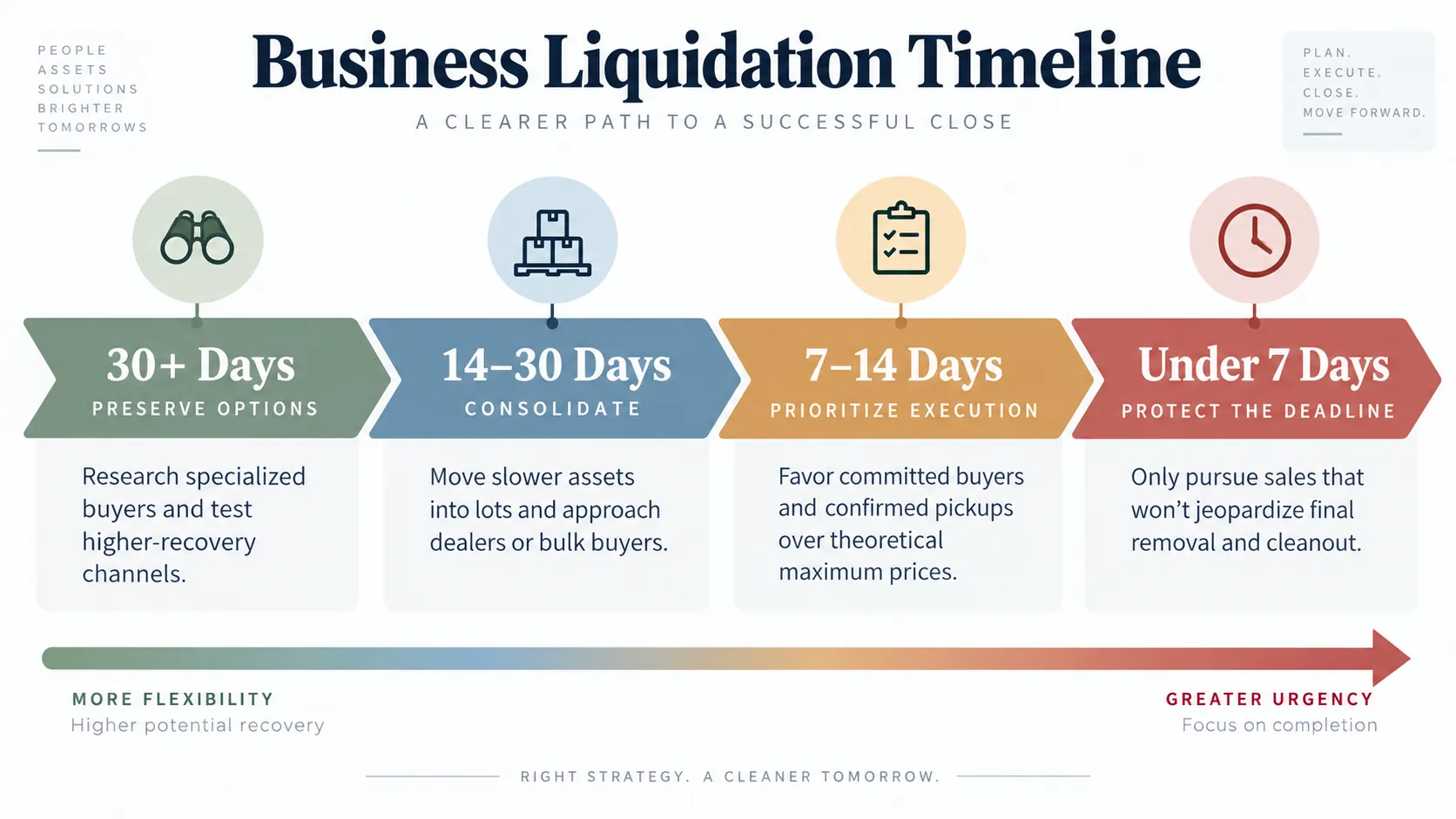
Business Liquidation Timeline
| Time Remaining | Primary Objective | What Changes |
|---|---|---|
| 30+ days | Preserve options | Research specialized buyers, test higher-recovery channels and market valuable assets individually. |
| 14–30 days | Consolidate | Move slower assets into lots, approach dealers and bulk buyers, and stop starting low-probability selling projects. |
| 7–14 days | Prioritize execution | Favor committed buyers, confirmed pickups and simpler transactions over theoretical maximum prices. |
| Under 7 days | Protect the property deadline | Only pursue sales that can be completed without jeopardizing final removal and cleanout. |
This does not mean every business should accept low offers when a deadline approaches.
It means the cost of an incomplete transaction increases.
A buyer offering $8,000 but unable to collect the equipment for three weeks may be less useful than a $6,500 buyer arriving Thursday if your lease ends Friday.
Work backward from the deadline.
Leave time for:
- Buyer no-shows
- Partial pickups
- Loading delays
- Removal equipment
- Building access restrictions
- Cleanup after assets leave
- Items that never sell
- Final walkthrough or property handoff
2. Build a Working Asset Inventory
You do not necessarily need to catalog every stapler, extension cord and half-used box of supplies.
You need enough information to make decisions and communicate with buyers.
Start by dividing the property into meaningful asset groups.
Examples:
- Packaged retail inventory
- Warehouse inventory
- Machinery
- Power tools
- Shop equipment
- Office furniture
- Electronics
- Shelving
- Pallet racking
- Retail displays
- POS equipment
- Appliances
- Materials and consumables
- Scrap or recyclable material
Then identify the items or groups that deserve further evaluation.
Business Asset Worksheet
Use a worksheet with at least these fields:
| Field | Why It Matters |
|---|---|
| Asset / Description | Identifies what is being sold |
| Category | Allows similar assets to be grouped |
| Quantity | Critical for bulk offers |
| Brand | Helps buyers evaluate demand |
| Model / SKU | Important for equipment and packaged inventory |
| Condition | Affects value and buyer interest |
| Working Status | Particularly important for equipment |
| Approx. Dimensions | Helps with transport planning |
| Current Location | Useful in larger facilities |
| Ownership Status | Owned, leased, financed or unknown |
| Photo Available | Makes buyer outreach faster |
| Estimated Market Range | Working estimate—not necessarily expected proceeds |
| Removal Difficulty | Low / Moderate / High |
| Proposed Exit | Individual, bulk, dealer, auction, etc. |
| Offer Received | Tracks actual market feedback |
| Buyer | Contact or company |
| Pickup Requirements | Loading, dock, liftgate, forklift, disassembly, etc. |
| Pickup Date | Turns a sale into an actual exit |
| Removed | Yes / No |
Download the Business Liquidation Workbook (.xlsx)
The workbook includes an asset inventory, buyer and pickup tracker, and a backward-planned liquidation timeline.
Don't over-document low-value assets.
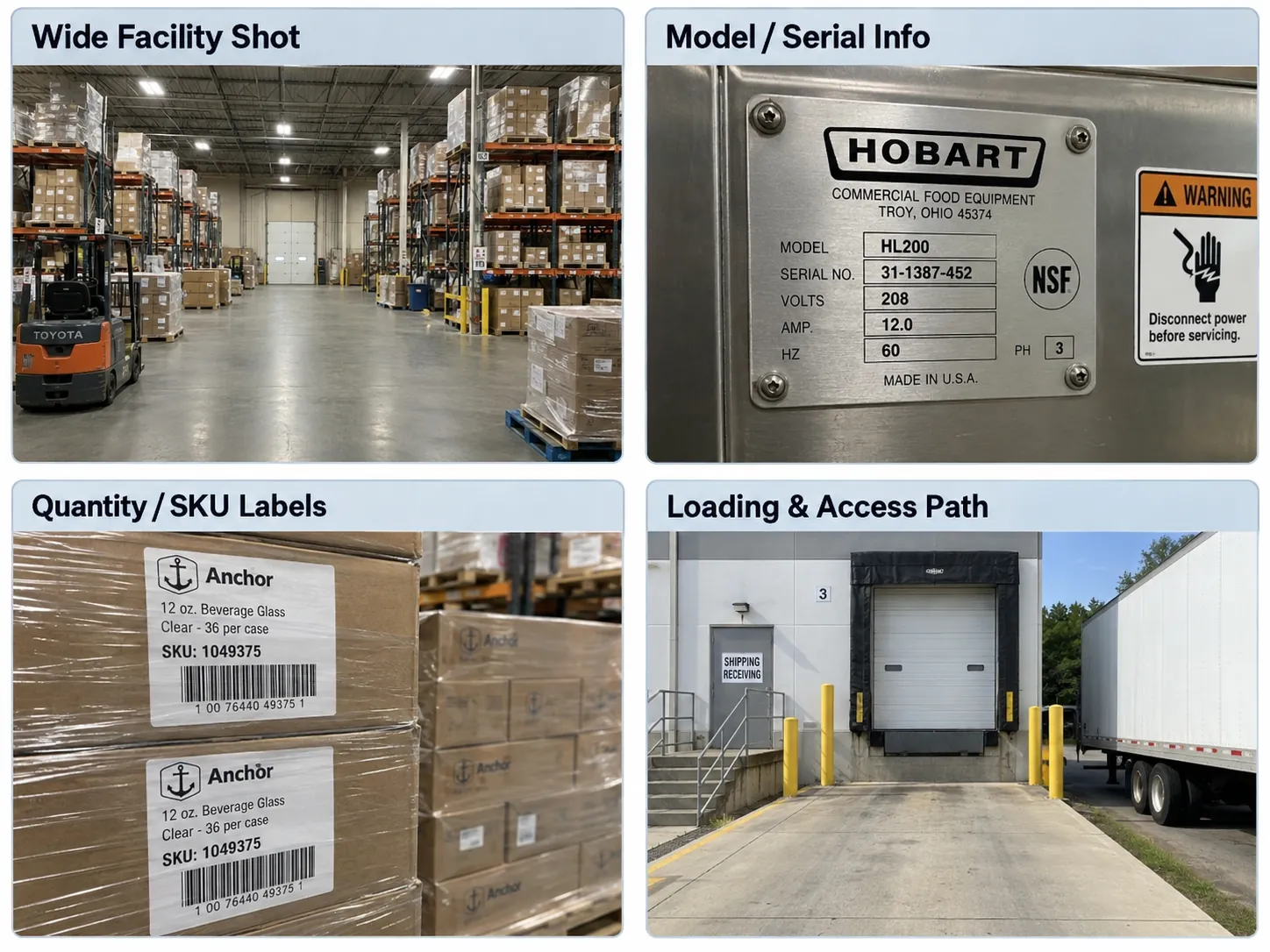
If you have 800 identical packaged products, photograph:
- The entire quantity or storage area
- Several representative units
- The packaging
- Product/SKU labels
- Cases or pallets
- Any visible damage
You probably do not need 800 individual photos.
For equipment, capture:
- Full unit
- Manufacturer label
- Model number
- Serial number when appropriate
- Controls
- Power requirements
- Accessories
- Visible damage
- Area surrounding the equipment
Also photograph the removal path when access may matter.
A buyer evaluating a 1,200-pound machine needs to know more than what the machine looks like.
3. Market Value Is Not the Same as Net Recovery
This is one of the most important distinctions in business liquidation.
An item can be “worth” $500 and still be a poor $500 liquidation asset.
Why?
Because somebody has to:
- Find the buyer
- Photograph it
- Market it
- Answer questions
- Collect payment
- Coordinate pickup
- Move it
- Potentially store it
- Deal with the transaction if the buyer disappears
The useful number is not simply the expected selling price.
Net Recovery
Net Recovery = Expected Sale Proceeds − Selling Costs − Holding Costs − Removal Costs
Selling Costs
May include:
- Marketplace or auction fees
- Commission
- Credit-card or payment fees
- Advertising
- Staff time
- Photography
- Buyer communication
- Packaging
Holding Costs
May include:
- Additional rent
- Utilities
- Insurance
- Storage
- Delayed property handoff
- Staff time spent maintaining access
Removal Costs
May include:
- Labor
- Disassembly
- Forklift or pallet jack
- Liftgate
- Rigging
- Freight
- Dumpster or disposal
- Final cleanup
Example: The $10,000 Office Furniture Lot
Imagine a business has 50 desks.
Someone searches comparable listings and concludes:
“These desks are worth $200 each.”
That produces a theoretical resale value of:
50 × $200 = $10,000
But suppose selling individually ultimately produces:
$7,000 in actual sales
Then subtract:
- $600 in selling, advertising and payment costs
- $900 in additional occupancy and staff time
- $1,200 in loading, handling and leftover removal
Your approximate net recovery becomes:
$4,300
Now imagine a used office furniture dealer offers:
$4,750 for everything, with one confirmed pickup.
The dealer's offer is substantially below the original $10,000 theoretical value.
But economically, it may be the better transaction.
That is why liquidation decisions should be based on realistic net recovery and execution, not the highest price you can find on an individual online listing.
Figures above are illustrative, not estimates of current furniture values.
4. Match the Exit Method to the Asset
One of the most common mistakes in a business liquidation is trying to force every asset through the same sales channel.
A warehouse full of packaged inventory should not necessarily be sold the same way as a commercial mixer.
A pallet rack should not necessarily be sold the same way as an office chair.
A liquidation can involve several exit methods at the same time.
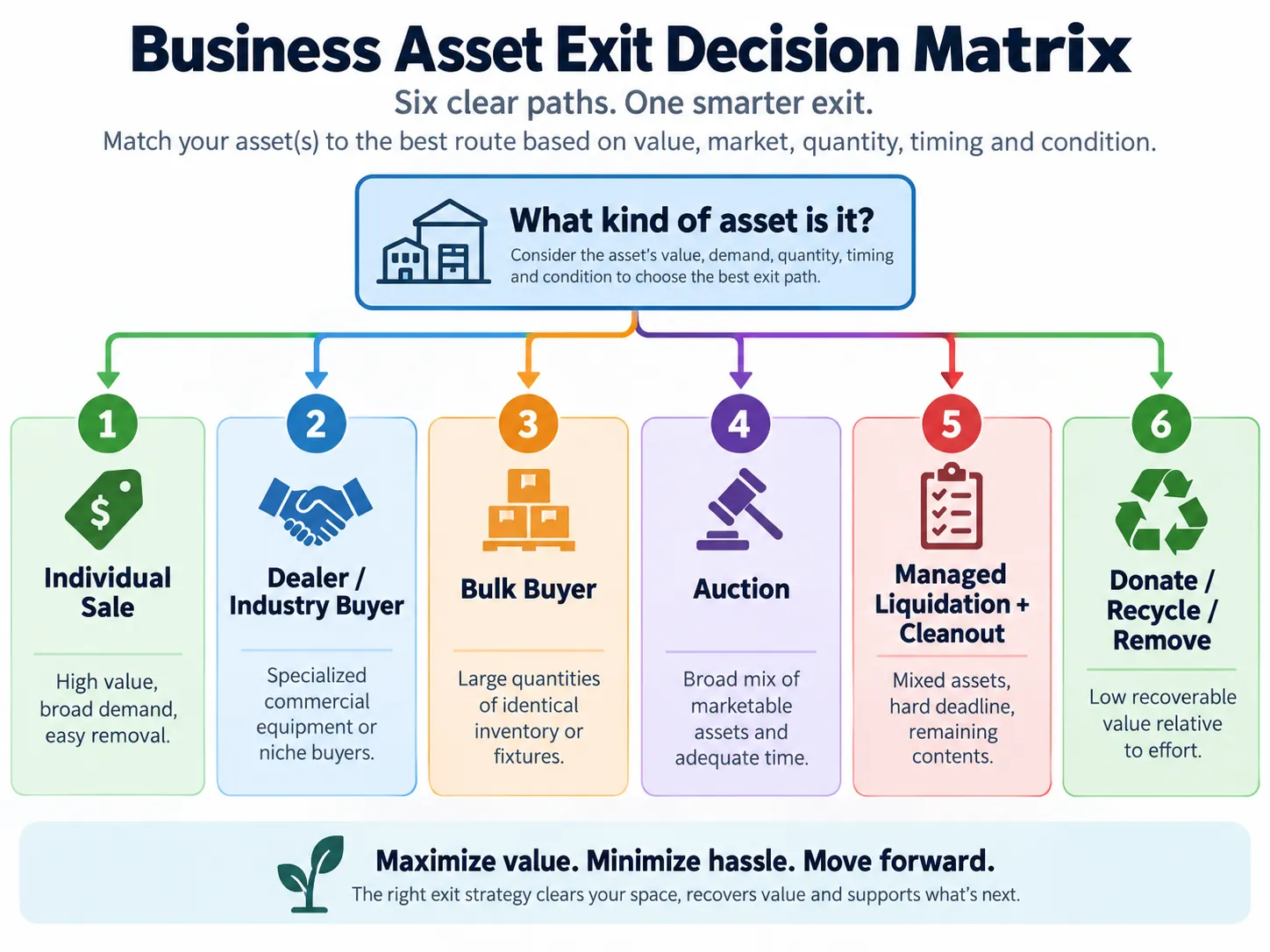
Business Asset Exit Decision Matrix
| Asset Situation | First Option Worth Investigating |
|---|---|
| High value + broad demand + easy removal | Individual/direct sale |
| High value + specialized commercial use | Dealer or targeted industry buyer |
| Large quantity of identical inventory | Bulk buyer |
| Broad mix of marketable assets + adequate time | Auction |
| Valuable assets that can remain available longer | Consignment / managed resale |
| Mixed facility + deadline + remaining contents | Managed liquidation + cleanout |
| Low value compared with selling effort | Donation, recycling or removal |
This is a triage tool—not a valuation table.
The actual decision depends on the asset, local demand, quantity, condition, access and deadline.
Option 1: Individual Sale
Selling directly to an end user can produce strong recovery when an asset has:
- Recognizable value
- Broad demand
- Manageable transportation
- Enough time to find the right buyer
This is often attractive for individual tools, electronics, specialty equipment and certain pieces of furniture.
The tradeoff
Individual sales require individual transactions.
Twenty assets can mean:
- Twenty listings
- Twenty buyer conversations
- Twenty payment arrangements
- Twenty pickups
Use individual sales where the added recovery justifies the effort.
Option 2: Specialized Dealer or Industry Buyer
Commercial equipment may be worth substantially more to someone who already understands it.
Examples could include:
- Restaurant equipment dealers
- Used machinery dealers
- Office furniture dealers
- Material-handling equipment buyers
- Industrial equipment resellers
- Electronics recyclers
- Specialized trade buyers
A dealer may pay less than an eventual end user, but can offer:
- Faster evaluation
- Familiarity with the asset
- Transportation resources
- Larger purchases
- Fewer transactions
For difficult commercial equipment, the buyer's ability to remove it may be nearly as important as the price.
Option 3: Bulk Buyer
Bulk selling is particularly useful for:
- Overstock
- Discontinued inventory
- Packaged goods
- Repeated SKUs
- Similar furniture
- Large quantities of fixtures
- Excess materials
Instead of asking:
“What is one worth?”
ask:
“What would a buyer pay to take 200 of them?”
Those are different markets.
Bulk transactions generally sacrifice some per-unit recovery in exchange for:
- Faster movement
- Fewer transactions
- Simpler pickup
- Reduced staff time
- Reduced holding costs
Prepare bulk inventory properly.
Buyers usually want to understand:
- Product
- Brand
- SKU/model
- Quantity
- Condition
- Packaging
- Expiration or dating where relevant
- Pallet/case configuration
- Location
- Loading availability
- Whether the buyer must take all or can take part
The clearer the lot information is, the easier it is for a serious buyer to make a decision.
Option 4: Auction
An auction can make sense when there is:
- A broad mix of assets
- Sufficient buyer interest
- A defined timeline
- Enough value to justify the sale process
Auctions can also consolidate buyer discovery instead of negotiating every asset separately.
But “auction” does not automatically mean every asset will sell well—or sell at all.
Before choosing one, understand:
- Seller fees
- Buyer premiums
- Marketing plan
- Sale timeline
- Minimums or reserves
- Pickup responsibility
- Unsold items
- Cleanup after the auction
The important question is not simply:
“Can this be auctioned?”
It is:
“What happens to the building after the auction is over?”
Option 5: Consignment or Managed Resale
Consignment can work when valuable assets have time to find buyers and immediate removal is not required.
It becomes more difficult when:
- The lease is ending
- Storage is expensive
- Assets are bulky
- The seller needs a guaranteed completion date
Managed resale can also involve multiple channels instead of traditional consignment.
The goal is to let someone else manage buyer discovery and coordination while preserving more recovery than a quick bulk disposal might produce.
Option 6: Donation, Recycling or Removal
Not every asset should be sold.
That is not a failure.
Some items have resale value but not enough recoverable value to justify:
- Listing
- Buyer communication
- Labor
- Storage
- Pickup coordination
Others may be useful to a nonprofit, appropriate for recycling or simply at the end of their practical life.
A productive liquidation process identifies these items early instead of allowing $25 decisions to consume $100 worth of labor.
5. Three Realistic Business Liquidation Scenarios
The easiest way to see how this works is to apply several exit methods to one property.
Example A: Office Relocation
A Tulsa-area company is relocating and has:
- 40 desks
- 55 office chairs
- 8 filing cabinets
- 12 monitors
- Conference furniture
- Breakroom contents
- One copier
- Miscellaneous electronics
The first mistake would be listing everything individually.
Step 1: Verify ownership.
The copier turns out to be leased.
It comes off the liquidation list and goes through the leasing company's return process.
Step 2: Separate the higher-value assets.
Twenty ergonomic chairs have strong resale potential.
They may justify targeted resale or dealer outreach.
Step 3: Group the commodity furniture.
Desks and filing cabinets are offered as grouped lots to used office furniture buyers.
Step 4: Address electronics separately.
Monitors and other equipment are evaluated based on condition, specifications and whether they contain business data.
Step 5: Plan what remains.
Breakroom contents, damaged furniture and miscellaneous low-value items are assigned to donation, recycling or final removal.
One office. Multiple exit channels.
Example B: Retail or Warehouse Shutdown
A business has:
- 800 units of packaged inventory across several SKUs
- Gondola shelving
- Two pallet racks
- POS equipment
- Shopping carts
- Warehouse equipment
- Miscellaneous fixtures
Trying to sell 800 products to individual consumers may create months of work.
Instead:
Inventory
Group inventory by:
- Product family
- SKU
- Quantity
- Condition
- Packaging
Then test:
Bulk reseller → smaller wholesale lots → selective individual resale
depending on demand and deadline.
Shelving and racking
These go to different buyers than the merchandise.
Dimensions and removal requirements matter.
POS equipment
Evaluate independently based on age, ownership and whether data needs to be removed.
Miscellaneous fixtures
Group wherever possible.
Anything without enough recoverable value moves toward donation, recycling or final removal.
The important insight:
The buyer for the merchandise does not need to be the buyer for the building's contents.
Example C: Contractor or Commercial Shop
A contractor is downsizing a shop containing:
- Power tools
- Larger shop equipment
- Shelving
- Ladders
- Consumable materials
- Scrap metal
- Office contents
- Miscellaneous accumulated items
A sensible first pass might route:
Higher-value equipment → targeted buyers
Common tools → grouped lots or individual resale
Consumables → bulk lot
Scrap metal → recycling
Office contents → grouped sale or donation
Remaining low-value contents → removal
Again, liquidation is not one sale.
It is routing each asset category toward the most practical exit.
6. A Buyer Is Not an Exit Plan Until the Pickup Works
An offer can look fantastic and still fail the liquidation.
Before considering an asset or lot “handled,” confirm the transaction all the way through removal.
Buyer & Pickup Checklist
Asset Agreement
Payment
Pickup
Building Access
Failure Plan
Download the Complete Business Liquidation Workbook (.xlsx)
Do not discover at 3:00 p.m. on your final lease day that the buyer thought you were delivering 60 desks.
7. Plan for What Doesn't Sell
A liquidation plan is incomplete until it answers:
What happens to everything that nobody buys?
The highest-value assets may represent only a small portion of the physical contents of the building.
After they leave, you may still have:
- Broken furniture
- Partial inventory
- Packaging
- Displays
- Old supplies
- Obsolete electronics
- Storage-room contents
- Damaged goods
- Trash
- Miscellaneous items nobody accounted for
Decide early how remaining contents will be routed.
Donation
Appropriate when items are usable and a recipient is available.
Confirm what the organization accepts and whether pickup is available.
Recycling
Appropriate for materials such as certain metals, electronics, cardboard or other recyclable commercial material.
Specialty Handling
Some materials, electronics, chemicals, batteries, refrigerants or regulated products may require specialized handling.
Do not place those into ordinary disposal streams without verifying the appropriate process.
Final Commercial Cleanout
When the property still contains mixed contents after the resale phase, a final cleanout can close the gap between:
“We sold the valuable assets.”
and
“The property is actually empty.”
That distinction is easy to miss at the beginning of a liquidation.
It becomes very obvious at the end.
8. When Managing the Liquidation Yourself Makes Sense
A business owner does not always need a liquidation company.
Handling it internally may work well when:
- There are only a few meaningful assets
- Assets have obvious buyers
- Staff has time to manage transactions
- Transportation is simple
- There is no urgent property deadline
- Remaining contents are minimal
For example:
Three pieces of desirable equipment with a month to sell them may be straightforward.
A 10,000-square-foot property containing inventory, furniture, equipment, shelving and miscellaneous contents is a different project.
9. When Managed Business Liquidation May Make More Sense
Outside help becomes more useful when several problems overlap:
- There are multiple asset categories
- Different types of buyers are needed
- Inventory quantities are large
- Staff is already focused on closing or relocating
- Assets require substantial pickup coordination
- The property deadline is approaching
- There will still be contents left after the valuable assets sell
- You need the resale process and final cleanout working from the same plan
A managed liquidation does not necessarily mean selling everything to one liquidation company.
Different projects may involve:
- Targeted buyer outreach
- Bulk buyer placement
- Dealer relationships
- Managed resale
- Selective direct purchase
- Pickup coordination
- Donation or recycling
- Final commercial cleanout
The objective is to build the right exit around the assets and the deadline.
Learn more about Bauman Bounty’s managed business liquidation and commercial cleanouts.
Business Liquidation & Commercial Cleanouts in Tulsa
Bauman Bounty helps Tulsa-area businesses evaluate marketable inventory, equipment and fixtures, coordinate practical buyer exits and handle the remaining commercial cleanout when needed.
You do not need to create a perfect inventory before contacting us.
For an initial look, send:
- Wide photos of the space
- Representative photos of inventory and equipment
- Approximate quantities
- Your location
- Access and loading details
- The date the property needs to be cleared
We'll help determine what looks worth pursuing before creating more work for your team.
Business Asset Liquidation FAQs
What does it mean to liquidate business assets?
Business asset liquidation generally means converting physical business property into cash or otherwise disposing of it as part of a closure, relocation, downsizing or inventory reduction.
In practice, that may involve several methods rather than one sale.
Inventory could go to a bulk buyer while equipment goes to a dealer, furniture is sold separately and remaining contents are donated, recycled or removed.
What is the best way to liquidate business inventory?
It depends heavily on quantity, demand, condition, packaging and available time.
Possible options include:
- Individual resale
- Wholesale lots
- Bulk buyers
- Dealers or resellers
- Auctions
- Consignment or managed resale
- Selective direct purchase
Large quantities of identical packaged inventory often deserve bulk-buyer evaluation before committing to hundreds of individual sales.
How do I sell equipment when closing a business?
Start by documenting:
- Manufacturer
- Model
- Serial number where appropriate
- Age
- Operating condition
- Power requirements
- Accessories
- Dimensions
- Removal requirements
Then identify whether the equipment has broad resale demand or is better suited to a specialized dealer or industry buyer.
Do not overlook transportation and removal.
A serious equipment buyer needs to know how the asset will actually leave the property.
Should I auction my business assets?
An auction can be appropriate for a broad mix of assets with sufficient buyer interest and enough total value to justify the process.
Before choosing an auction, understand the fees, marketing plan, timeline, pickup process and what happens to unsold assets.
An auction solves the property-clearing problem only if the remaining items and post-sale cleanup also have a plan.
Should I sell business assets individually or in bulk?
Individual sales may produce greater gross revenue per unit.
Bulk sales may reduce:
- Selling time
- Staff involvement
- Number of transactions
- Pickup coordination
- Holding costs
Compare expected net recovery, not simply individual asking prices.
What if my business assets aren't worth as much as I expected?
Original cost is not the same as current resale value.
Age, condition, demand, quantity, transportation cost and time all affect what buyers are willing to pay.
If professional valuation is required for tax, legal, insurance, financing or court purposes, use a qualified appraiser rather than relying on informal resale estimates.
How long does a business liquidation take?
There is no universal timeline.
A few pieces of desirable equipment may move quickly.
A large mixed facility may require weeks of inventory work, buyer outreach, multiple pickups and final removal.
If the property has a hard deadline, build the liquidation plan backward from that date and become progressively more selective about sales that could delay the final cleanout.
Do I need an inventory list before contacting a liquidation company?
Not necessarily.
For an initial evaluation, wide photos, approximate quantities, major asset categories and a firm property deadline can provide enough information to determine the next step.
Detailed inventory becomes more useful once the project is divided into meaningful asset groups.
What happens to business assets that don't sell?
Depending on the item and project, remaining assets may be:
- Donated
- Recycled
- Sold as a lower-value bulk lot
- Routed to specialty disposal
- Included in the final commercial cleanout
A complete liquidation plan should address unsold contents before the selling period ends.
Business Liquidation Planning Checklist
Before launching the liquidation, confirm:
Deadline
Assets
Sales
Buyers
Final Property Exit
Recover the Value. Clear the Rest.
The most successful business liquidation is not necessarily the one with the highest total asking prices.
It is the one that makes intelligent decisions about where selling effort is worthwhile, gets assets into the hands of buyers who can actually remove them, and leaves the property ready for whatever comes next.
If you're handling a business closure, relocation, downsizing project or excess inventory in the Tulsa area, Bauman Bounty can help evaluate the project and determine whether managed liquidation, bulk buyer placement, resale, commercial cleanout—or a combination—makes sense.
Business Liquidation & Commercial Cleanouts
Last updated September 2026 · Published by Bauman Bounty